“What Scale Do I Play over This Chord?”
Or: how I learned to stop hunting for a new scale over every chord.
(Developed from notes I made after lessons of my own. I teach bass in Edinburgh, and I am still a student too, which I think is the correct arrangement.)
“What scale should I play over this chord?” is one of the questions I hear most often once a player starts improvising.
I often answer: “the same scale you were already playing, with a different emphasis, and sometimes with one important note changed.” This is often met with some disappointment.
It is a sensible question. It is also usually one step too far ahead.
It is not uncommon for musicians to reach the point where they have learned the modes of the major scale and feel they now have to “play the changes”, loading up a new scale for each chord that goes by. In many cases this is not necessary, and in some it is actively counter productive.
The thing is: most chords in a song are not asking you to abandon one scale and load another. They belong to the same key as the chords around them. What changes from chord to chord is not necessarily the collection of appropriate notes, but the importance of each note within it.
The more useful question is:
What does this chord change, and which note will make that change audible?
That turns improvising from a memory test into a listening problem. Here is how to work on it:
First, learn the melody
Not just the chord chart. Learn the actual tune, note for note.
An improvised solo is (in some ways) a melody you make up as you go along, and the written melody is already a worked example of which notes sound good over these exact chords, in which register, in which rhythm and at which point in the bar.
Learn it, then investigate it:
- Where does it rest?
- Where does it move by step, and where does it leap?
- Which notes land on strong beats?
- What does it play over the unusual chord?
- How does it lead into the next phrase?
You will often hear the important harmonic moments in the melody before you can name them in theory.
A chord symbol is not a complete scale instruction
A chord symbol tells you the notes that define the harmony at that moment. It does not, by itself, tell you every other note you may play.
Context does that: the key, the melody, the previous chord, the next chord, the style and the length of time the chord lasts.
It helps to think in three layers:
- Chord tones are your clearest landing points.
- Other notes from the key connect those landing points and add colour.
- Chromatic notes create tension, movement or surprise (and usually need to go somewhere).
All three layers are useful, but they are not equally stable.
Q: What is the simplest note pool that works?
Take this loop:
Em – D – C – D
Every note in those chords belongs to E natural minor:
E – F♯ – G – A – B – C – D
There is no harmonic reason to choose a new scale for every bar. E natural minor covers the whole progression. E minor pentatonic (E, G, A, B, D) gives you an even simpler set of notes, with a strong blues, rock and soul vocabulary already built into it.
That does not mean every note has the same effect over every chord. An E may feel settled over Em, like a ninth over D and like a major third over C. The note pool stays the same while the hierarchy changes.
So keep the scale, but follow the chords. Aim for notes belonging to the chord when the harmony changes, then use the rest of the scale to travel between them.
Rather than asking which note is strongest over each chord in isolation, it is more useful to ask which note gets you smoothly into the next one:
| Chord | Chord tones | A note that leads on… |
|---|---|---|
| Em | E, G, B | G, falling a semitone to F♯ |
| D | D, F♯, A | F♯, rising a semitone to G |
| C | C, E, G | E, falling a tone to D |
| D | D, F♯, A | F♯, falling a tone to E |
You do not have to hit a root on every change. On bass, that can quickly sound like a bass line wearing a false moustache. Thirds, sevenths and other smoothly connected chord tones often make the harmony clearer with less effort.
Q: What changed?
Now alter one chord:
Em – D – C – B7
The B7 is doing something new. It contains B, D♯, F♯ and A. Three of those notes already belong to E natural minor. The only newcomer is D♯.
That D♯ is the leading note of E minor. It sits a semitone below E and pulls strongly towards it. Far from being a complication, it tells you exactly what the chord is for: B7 is pushing us home to Em.
If scale names are useful to you, the note pool over B7 can be described as B Phrygian dominant, which contains the same notes as E harmonic minor. But you do not need to replace one large mental diagram with another. The practical instruction is smaller:
When B7 arrives, change D to D♯, then let D♯ resolve to E.
One chord changed. One note changed. That one note explains the whole cadence.
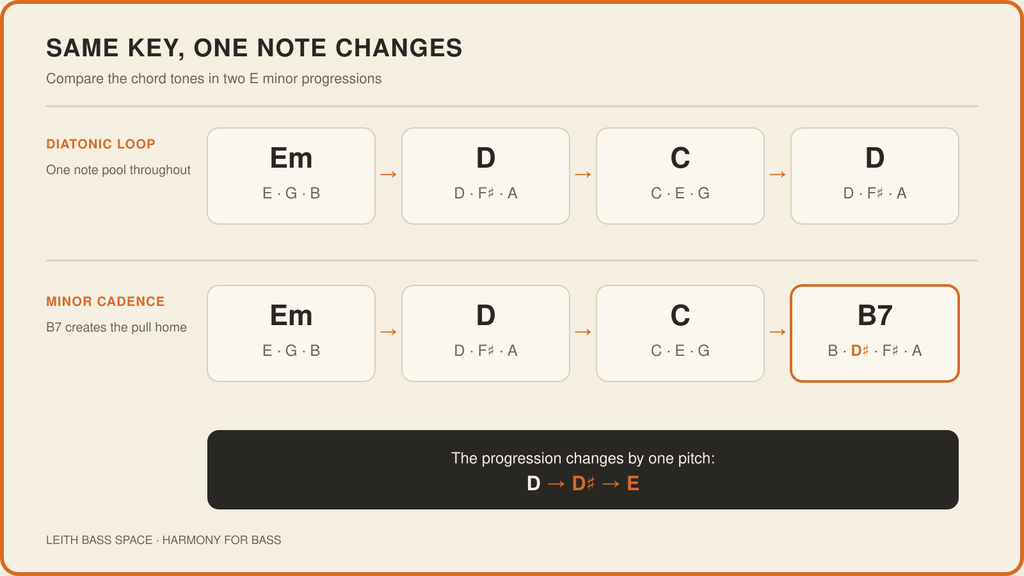
Both progressions begin with the same three chords. Replacing the final D with B7 introduces D♯, the leading note that pulls back towards E.
You may find this way of thinking is a more useable way to approach harmony than collecting seven note answers to four note questions.
Q: What has the chord symbol already decided?
Musicians sometimes talk about “allowed” and “forbidden” notes. In practice, almost any note can work if its tension is intentional and its resolution convincing. A better distinction might be between notes that are stable, notes that are available as colour, and notes that are decidedly not neutral.
Suppose you see Cm7. Its chord tones are C, E♭, G and B♭. C Dorian, C Aeolian and C Phrygian all contain those four notes. What separates the scales is what happens to the second and sixth degrees:
- Dorian has D and A
- Aeolian has D and A♭
- Phrygian has D♭ and A♭
The symbol Cm7 has not chosen between them. The surrounding music will.
Written extensions narrow the field. Cmaj7 may appear in either an Ionian or a Lydian setting; Cmaj7♯11 explicitly gives you F♯ rather than F natural. B7♭9 tells you that C natural is part of the intended colour. The more information the chord symbol contains, the fewer decisions remain open.
Read extensions as evidence. They do not merely add notes; they tell you which tensions the harmony considers important.
This is also the basis of playing “outside”. Moving a familiar phrase up a fret is easy. Making it sound deliberate depends on hearing which expectation you are breaking, how much tension you have created and where the phrase will return. You need to establish the ground before stepping away from it.
Two bags of language
If you have strong pentatonic and blues vocabulary, it is likely that you will always have something convincing to say.
Think of your improvising language as two bags.
Bag one contains fundamentals: major and minor pentatonic language, chord tones, blues phrases, strong rhythms, repetition and space. It works under pressure, at tempo, when you are tired and when the monitors are horrible.
Bag two contains stronger colours: modes, altered dominants, diminished and melodic minor sounds, chromatic approaches and sidestepping. It can create wonderful tension, but it rewards preparation and punishes bluffing.
Bag one is not the beginner bag, and it is not less musical or worthy or important. Bag two is there when the harmony, the shape of the solo or your ear gives you a reason to reach for it.
A solo that never leaves bag one may very well still be excellent. If you do not enjoy a good pentatonic shred then I do not know what to tell you. A solo that dips into bag two at exactly the right moment can be thrilling, sophisticated and deep. A solo that empties bag two onto every chord is (in my opinion at least) often tiring for everyone.
Where is the chord going?
A chord’s destination is often more informative than its name.
The B7 above matters because it resolves to Em. Play D♯ over B7 and E over Em, and you have expressed the function of both chords with two notes and one fret of movement.
This is why it is worth learning to spot ii–V–I and ii–V–i progressions. A diatonic ii–V–I in a major key may not require a new note pool at all, but its chord tones still change their jobs from bar to bar. A minor cadence, a secondary dominant, or a ii–V pointing temporarily towards a new key is more likely to introduce a chromatic note that deserves your attention.
A secondary dominant is simply the dominant chord of somewhere other than the home key. Its altered note or notes create a temporary pull towards that destination. These are not awkward exceptions to get through; they are usually the most expressive notes in the progression.
When you find a functional chord, ask:
- What chord is this moving towards?
- Which note creates that pull?
- Can I approach the next chord tone by a semitone?
This is voice-leading: choosing notes for the path they make through the harmony, rather than treating each chord as a separate box.
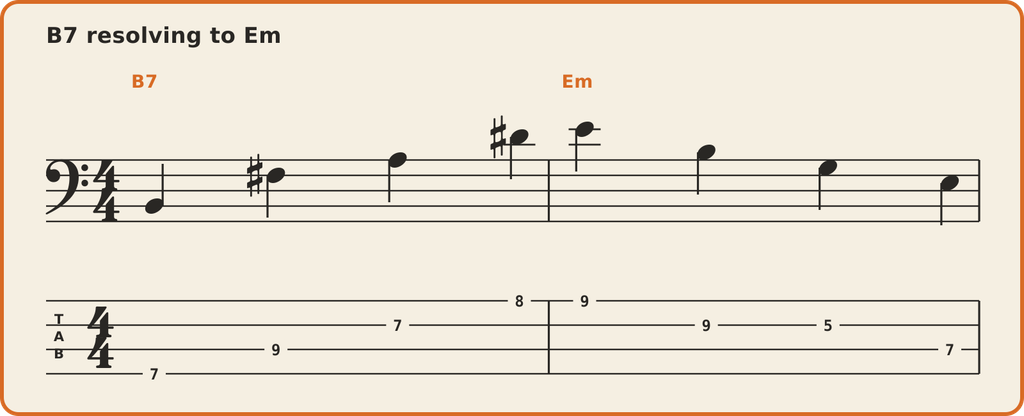
The final note over B7 is D♯ at the eighth fret of the G string. Move it up one fret as Em arrives and the function of both chords becomes audible.
Where, and for how long, are you playing it?
On bass, register changes the meaning of a note.
A low note carries enormous harmonic authority. If you play a chord’s third below the rest of the band, it may not sound like a colourful note over the chord; it may make the whole chord sound inverted. A low chromatic note can reshape the harmony altogether.
Higher up the neck, the ear is more likely to hear the same pitch as melody or colour. Extensions speak more clearly, chromatic approaches are easier to follow, and sustained notes are less likely to crowd the instruments above you.
This is not a rule that low notes must be simple and high notes clever. It is a reminder that the lower you play, the more strongly your note choice tells everyone else what the harmony is.
It is worth applying this to the B7 above. Its chord tones (B, D♯, F♯ and A) will speak clearly anywhere on the neck. The remaining colours of B Phrygian dominant, the C and the G, are far more exposed. Down low they will fight whatever is happening above you. An octave up, they sound like the intention they are.
Duration matters too. If a chord lasts half a bar at a fast tempo, spelling an exotic mode over it is probably less useful than landing on one clear chord tone. If it lasts four bars, there is time to explore its colour.
Return to the Em – D – C – D loop. If the C lasts long enough to feel temporarily settled, you can bring out the sound of C Lydian:
C – D – E – F♯ – G – A – B
Those are exactly the same seven notes as E natural minor. Nothing has been added. You simply make C feel like home and bring attention to F♯ and B, the ♯11 and major seventh above it.
Same notes, new centre, different hierarchy.
So: you usually do not need more notes. You need to hear which of the notes you already have are carrying the harmony now.
Some practical ways to practise this
Choose a tune you already know and make four passes through its chord progression.
Pass one: play the melody. Ideally transcribe it yourself. Play it accurately and hear how the note choices relate to each chord and its function. Mark any note that is particularly interesting, or that seems to reveal a change in the harmony.
Pass two: play only chord tones. Spell out the chords. Improvise using roots, thirds, fifths and sevenths. Find all the different shapes and spots on the neck where you can do this. Move to the nearest useful note when the chord changes. Leave space; this is not an arpeggio speed test. It is a great way to think about voice-leading and to really learn the fretboard.
Pass three: use one home scale. Play from the main key centre, but keep emphasising the chord tones. Notice that one scale can follow several chords when your targets change with them.
Pass four: honour the exceptions. Find every chord containing a note from outside the home scale. Add only those necessary changes, and listen to where they resolve.
Record all four passes. The third should sound more melodic than the second. The fourth should make the unusual chords clearer, rather than make the whole thing busier.
In closing
Learning more scales is useful. Learning to understand and hear what a chord is doing is better. The aim is not to have a different shape ready for every symbol on the page. It is to make the harmony audible, and to play deliberately, musically and expressively.
I’m Jack Elliot, a professional bassist and teacher based in Leith, Edinburgh. I teach complete beginners as well as experienced players working on improvisation, harmony and fretboard fluency. If you would like help applying this to your own playing, book a bass lesson in Leith.