Figured Bass, chord inversions, and why the bass note matters
A short history for bass players and a practical way to hear the difference between a chord’s root and its bass note.
Play C, E and G. Now put E at the bottom and play E, G and C. Are these two the same chord?
To a modern musician, yes: both are C major. But this has not always been the obvious answer. There are two useful questions are hiding inside the modern answer:
- What is the root of the chord?
- What note is actually in the bass?
The root tells us which harmonic family the notes belong to. The bass note tells us the shape we can hear: its weight, direction and connection to the chords around it. Those two notes may be the same, but they do not have to be.
Figured bass begins with the second question. Modern chord theory usually begins with the first. A bass player needs both.
I found my way into this when I fell down a rabbit hole by accident. It started with Nadia Boulanger (teacher of Aaron Copland, Astor Piazzolla, Philip Glass and Quincy Jones, among many others), which led me to a collection of “Given Basses” exercises by her former Conservatoire teacher, Paul Vidal. In these exercises, the student receives a bass line and supplies the harmony above it.
What I did not expect was where that simple exercise would lead: into several centuries of argument about what a chord actually is, in which bass players are not spectators, and which is of real relevance to the modern bassist.
Two ways of describing the same music
Keeping two ideas separate makes everything that follows easier:
Figured bass (also called thoroughbass) is a practical notation associated with basso continuo from around 1600. Numbers placed beneath or above a written bass note tell an accompanist which intervals to supply above it. The notation itself does not need to identify an abstract chord root; it works upwards from the bass that is actually sounding.
Chord inversion is a more modern “root-based” idea. It says that C–E–G, E–G–C and G–C–E can all belong to one C-major chord, even though each has a different note in the bass.
These were not invented in one clean sequence by one person. Theorists around 1600 were already describing triads and recognising relationships between their different arrangements. What Jean-Philippe Rameau did in 1722 was more ambitious: he made the succession of chord roots, or the fundamental bass, the foundation of a complete theory of harmony.
Modern analysis combines the two viewpoints. In V6/5, the Roman numeral identifies a chord by its root and function; the figures describe its position above the sounding bass. In C7/E, the chord symbol names the root while the slash specifies the bass note. We switch between root-down and bass-up thinking without always noticing.
Before figured bass
Renaissance musicians certainly heard and controlled vertical sonorities, but they did not usually explain a piece as a chain of chord roots in the modern way. Polyphonic music was taught and composed through interacting melodic lines, with careful rules governing consonance, dissonance and motion between voices.
The bass became increasingly important within that texture. Rather than treating every pair of voices equally, musicians began to use the lowest sounding part as the practical reference point from which the other intervals could be understood.
That change did not instantly create modern harmony, but it made figured bass possible.
Around 1600: the accompanist’s problem
Basso continuo developed through several overlapping practices. The new solo song and early opera needed flexible accompaniment beneath an expressive vocal line. Sacred musicians also needed practical organ parts that could support reduced or changing groups of singers. In both settings, a continuous bass line gave the accompanist a structural outline from which to improvise the remaining texture.
Lodovico da Viadana’s Cento concerti ecclesiastici of 1602 was not the first continuo publication, but it was enormously influential, and its preface became an important early guide to the practice. Within a few decades, continuo was central to music making across much of Europe.
Two points matter here.
Figured bass was a performance technology
It was a set of instructions to a player, closer in spirit to a chord chart than to a completed keyboard part. A continuo player supplied register, spacing, doubling, ornament and voice leading according to the musical context.
The parallel with a jazz pianist or guitarist comping from a lead sheet is useful, provided we treat it as an analogy rather than a direct historical line: the page gives a harmonic framework, but the musical result still depends on the player.
The figures work upwards from the sounding bass
A 6 literally asks for a sixth above the written bass note. It does not require the player to think, “this must be the first inversion of a chord whose root lies a third below”. That root-based translation is useful, but it belongs to a different layer of theory.
This bass-up orientation is the deep grammar of the notation.
How the figures work
One rule governs the system: figures indicate intervals above the written bass, using the key signature unless an accidental alters them.
The figures do not normally prescribe a fixed octave or voicing. A 6 may be realised in several musically sensible ways; what matters is the intervallic content and the voice leading.
Triads
| Figure | Intervals above the bass | Modern inversion name | On bass C, in C major |
|---|---|---|---|
none, or 5/3 | third and fifth | root position | C–E–G: C major |
6, short for 6/3 | third and sixth | first inversion | C–E–A: A minor/C |
6/4 | fourth and sixth | second inversion | C–F–A: F major/C |
An unfigured bass commonly implies a third and fifth. The third is also assumed beneath 6, so only the 6 needs to be written. In 6/4, both intervals differ from the default and both appear.
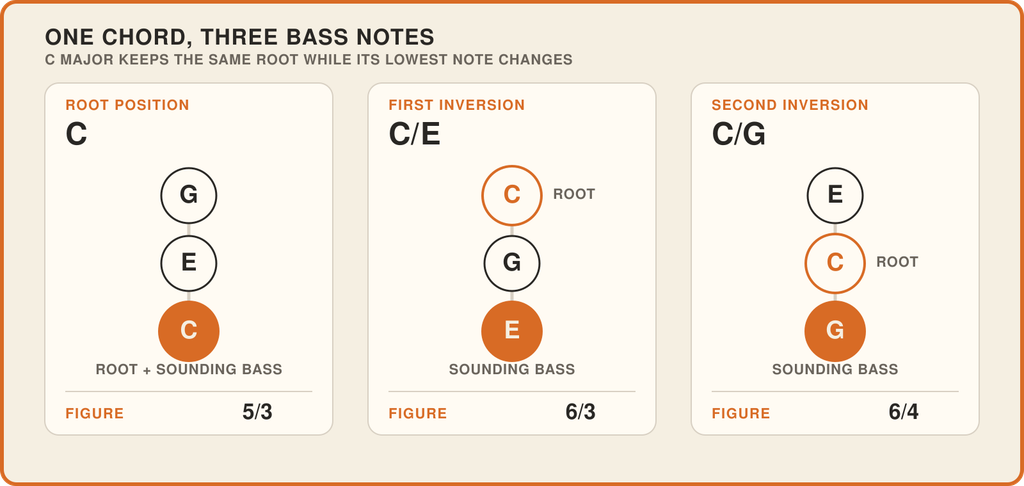
The chord root stays C while the sounding bass changes from C to E to G. Figured bass describes each stack from its lowest note; slash notation names the chord first and the bass second.
Seventh chords
| Figure | Full form | Modern inversion name | Chord member in the bass |
|---|---|---|---|
7 | 7/5/3 | root position | root |
6/5 | 6/5/3 | first inversion | third |
4/3 | 6/4/3 | second inversion | fifth |
4/2, or 2 | 6/4/2 | third inversion | seventh |
For example, C7/E has the intervallic shape 6/5: G, B-flat and C lie a third, fifth and sixth above the bass E. The B-flat still needs the appropriate alteration if the key signature supplies B-natural. G7/D is 4/3, and G7/F is 4/2.
The full figures form a useful sequence as the bass rises through the chord: 7, 6/5, 4/3, 4/2.
Accidentals and moving voices
An accidental attached to a figure alters that interval. An accidental written on its own conventionally alters the third above the bass. In C minor, G in the bass with a lone natural sign asks for B-natural rather than the B-flat supplied by the key signature, producing a major dominant.
Successive figures over one sustained bass note can show the upper voices moving while the bass remains still. This is one of the notation’s great strengths: it can show a 6–5 or 4–3 resolution directly, without pretending that every change of interval must be a new chord.
Rameau changes the centre of gravity
In his 1722 Traité de l’harmonie, Rameau proposed a fundamental bass: an underlying succession of chord roots distinct from the sounding bass line.
If E sits at the bottom of C–E–G, the heard bass is E but the fundamental bass is C. The sonority retains its C-major identity because C is its generating root. Rameau did not single-handedly discover triads or inversion; theorists had recognised both earlier. His decisive move was to make roots and their succession carry the explanation of harmonic motion.
That was a powerful simplification. Many different intervallic situations could now be grouped into a relatively small family of chords and inversions. It lies behind modern chord symbols, Roman-numeral analysis and the ordinary statement that “this is an F chord in first inversion”.
It did not make thoroughbass thinking disappear. Practical musicians continued to learn harmony from bass lines, figures, patterns and voice-leading rules. J. S. Bach’s teaching world is more accurately understood through that German thoroughbass tradition than through Rameau’s system, while later writers in Bach’s circle—including Johann Philipp Kirnberger—engaged root-based theory on their own terms.
The two orientations have coexisted ever since:
- Think from the root: what chord is this, and what is its function?
- Think from the bass: what intervals and voices are moving above this note?
Neither question makes the other unnecessary.
How bass-led harmony was taught
In eighteenth-century Italy, and especially in Naples, students learned through partimenti: instructional basses that served as frameworks for complete pieces improvised at the keyboard. Some were figured, many were not. A partimento was not simply a continuo accompaniment with the melody removed; it was a compressed composition from which the student had to recover harmony, counterpoint, pattern and form.
The Paris Conservatoire developed related paper exercises: the basse donnée, a given bass harmonised in several parts, and the chant donné, a given melody harmonised underneath. That is the lineage behind Paul Vidal’s collection and the exercises Nadia Boulanger used with her own students, later selected, revised and realised by Narcís Bonet.
The attraction is easy to understand. A given bass is not an exercise in naming things after they have happened. You must make the music work. Harmony, counterpoint, keyboard geography, inner hearing and voice leading are trained together.
The history is interesting. The exercise is the useful bit.
One progression, three descriptions
The cadential 6/4 brings the different layers into focus. In C minor, play:
Cm/G → G → Cm
Over the first G in the bass, the upper notes are C and E-flat. They then move to B-natural and D above the same bass before the progression resolves to C minor.
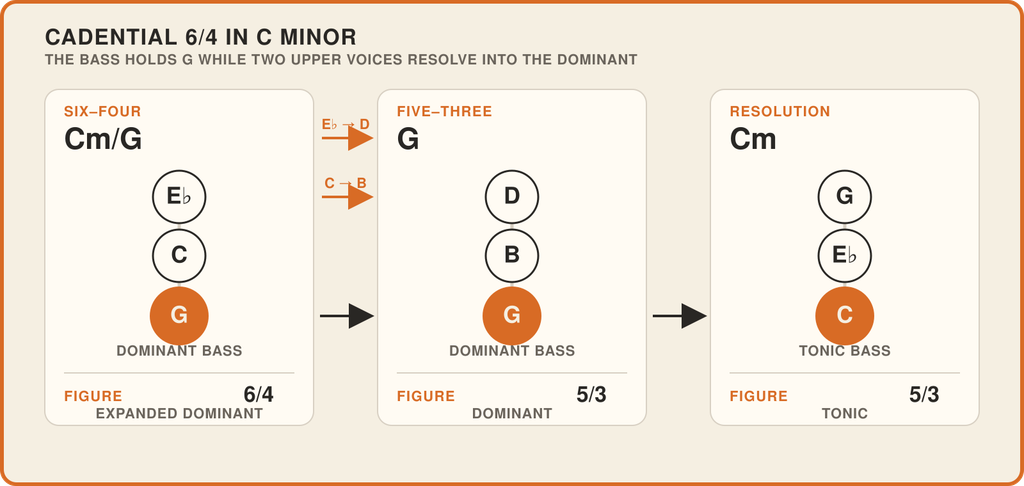
The first two sonorities share G in the bass. C falls to B-natural and E-flat falls to D, turning 6/4 into 5/3 before the final resolution to C minor.
The notes are not disputed. The descriptions simply prioritise different things.
The figured-bass description
Over G, 6/4 resolves to 5/3. The sixth falls to the fifth and the fourth falls to the third. The notation describes the sounding intervals and their resolution directly.
The chord-symbol description
The first sonority contains the notes of C minor with its fifth in the bass, so it is Cm/G. The next is G major. This description preserves each chord’s root identity.
The functional description
In a classical cadence, the 6/4 sonority does not sound like a tonic arrival. It intensifies the dominant and leans into its resolution. Many analysts therefore hear the entire 6/4–5/3 span over G as an expanded dominant, with two upper-voice dissonances resolving above the dominant bass.
That is why this is sometimes labelled i6/4–V and sometimes shown as a dominant carrying 6–5 and 4–3 motions. The disagreement is not about the pitches. It is about whether a label should foreground chord spelling, bass-relative voice leading or harmonic function.
For the bassist, the practical truth is unusually clear: G is the structural event. It normally stays in place or is rearticulated while the upper voices resolve. The bass establishes the dominant before the upper parts have fully revealed it.
Not every 6/4 is cadential. Passing, pedal and arpeggiated 6/4 sonorities behave differently, so context matters more than the figure alone.
Where both systems survive
Roman numerals with Arabic figures. A symbol such as V6/5 is a useful hybrid: V identifies the chord’s root and function, while 6/5 identifies the intervals above its bass.
Slash chords. Cm/G is also a hybrid. It is not figured bass in modern clothing, because the symbol still names a root-based chord first. But it preserves the old practical insight that the bass note deserves to be specified independently.
Lead sheets and rhythm sections. A jazz, soul or pop rhythm section often divides the labour in a way a continuo player would recognise: the bassist shapes the foundation while a chordal instrument supplies a texture above it. The traditions are not identical, but the performing problem—turn a shorthand into convincing harmony in real time—is strikingly similar.
Teaching and historical performance. Continuo never vanished as neatly as textbook period boundaries suggest, and figured bass remains active in early-music performance. As a teaching method, bass-led harmony also persisted through partimento, Conservatoire exercises and later analytical traditions.
What this changes for a bass player
The distinction between root and bass is not historical trivia. It affects how you play.
- The root names the harmony; the bass shapes its behaviour. C/E and C/G may belong to the same chord, but they do not have the same weight or the same likely destination.
- A slash chord is a line-writing instruction as well as a chord symbol. Read the note after the slash first. It tells you what your part must make structurally audible.
- Intervals above the bass explain colour quickly. If the keyboard is playing a fourth and sixth above your note, you can hear and name that relationship without first calculating a remote root.
- Function emerges across time. A bass note held beneath changing upper voices may reveal that several apparent “chords” are one prolonged harmonic event.
Root thinking is excellent for grouping and memory. Bass-up thinking is excellent for voicing, movement and tension. The useful question is not which system wins, but which one tells you what you need to hear next.
It is the same wider point behind choosing scales over chords: harmony makes more sense through movement and function than through isolated vertical snapshots.
If you want to work on this
The historical layers suggest a sensible learning order: intervals above the bass first, chord identity second, function third.
Make the figures automatic
At a piano, choose one major key and one minor key. Play a single bass note and build 5/3, 6/3, 6/4, 7, 6/5, 4/3 and 4/2 above it. Say the intervals before you play them. The aim is not speed but immediate recognition.
Convert in both directions
From chord to bass: “F minor in first inversion -what note must the bassist play?” A-flat.
From bass and figure to root: “E in the bass with 6/5 above it – what seventh chord does that produce in C major?” Cmaj7/E. Change B-natural to B-flat and the result becomes C7/E.
Then use a chart you already know as a worksheet. Mark every slash chord and ask what kind of inversion or non-chord bass it creates.
Hear the cadential 6/4
Loop Cm/G → G → Cm.
Hold or repeat G beneath the first two sonorities. Sing C–B–C, then E-flat–D–E-flat, while the bass remains fixed. This makes the voice leading physical rather than merely analytical.
Try a given bass
The goal here is to work through a Vidal exercise at the keyboard. Play it in four parts, then sing the bass while playing the upper voices. Finally, sing each upper voice in turn. The exercise may look elementary; the coordination of eye, hand and ear is not.
As ever, ten focused minutes most days will do more than a heroic session once a fortnight. This is fluency work, and fluency grows through frequent retrieval.
reference in C minor
| Written bass and figure | Notes produced | Modern reading |
|---|---|---|
| G, no figure | G–B-flat–D | minor v, following the key signature |
| G, lone natural | G–B-natural–D | major V |
G, 7 plus the raised third | G–B–D–F | V7 |
B-natural, 6/5 | B–D–F–G | G7/B, or V6/5 |
D, 4/3, with the sixth raised | D–F–G–B | G7/D, or V4/3 |
F, 4/2, with the fourth raised | F–G–B–D | G7/F, or V4/2; the bass normally falls to E-flat |
G, 6/4–5/3, with B-natural at the resolution | G–C–E-flat → G–B–D | cadential 6/4 resolving over the dominant bass |
Further reading
- Joel Lester, “Root-Position and Inverted Triads in Theory around 1600”, on triadic thinking before Rameau.
- Jean-Philippe Rameau, Treatise on Harmony, in an early English translation of part of the 1722 treatise.
- Derek Remeš, “New Sources and Old Methods”, on thoroughbass and J. S. Bach’s compositional pedagogy.
- Giorgio Sanguinetti, The Art of Partimento, on the Italian bass-led teaching tradition.
- Open Music Theory, “Classical cadence types”, for the voice-leading construction of the cadential
6/4.
If this is the kind of thing you would like to get your hands and ears into, it is exactly the sort of thing we can explore in a session at The Leith Bass Space. Get in touch.