Practice Makes Permanent: How to Practise Properly
Effective practice is not simply time spent with an instrument. It is the process of noticing what is happening, changing something deliberately, and returning often enough for the change to hold.
This is the first in a series of pieces about practice. Good practice.
So naturally, let’s start with bad practice: it is very easy to spend time practising without having improved very much. There is also the very real possibility of spending your practice time solidifying bad habits, covering familiar ground and, effectively, going backwards. (You know what it is: wander through a few exercises, run through a song, get stuck in the same places, play them again, and perhaps finish with something you already know and like. Cup of tea.)
Not every encounter with an instrument needs to be an exercise in self-improvement. Playing for fun is great. But it is worth knowing which one you are doing, because when the aim is learning, the way you practise matters enormously.
I know this because I have taken a great many roads to nowhere. This series is my effort to share the map of the territory with you.
There are things that I have played incorrectly for years without realising. Or maybe I half realised but didn’t have the process in place at the time to correct it and so the “bad pathway” became the royal road, repetition clearing away the scrub, my playing getting worse.
This is not to say I was being lazy. On the contrary, I was really trying my best to improve. Sometimes these “incorrect pathways” are a consequence of diligent, hard work. An uncomfortable truth, though: the instrument neither knows nor cares whether you are trying hard. It only registers what you actually do.
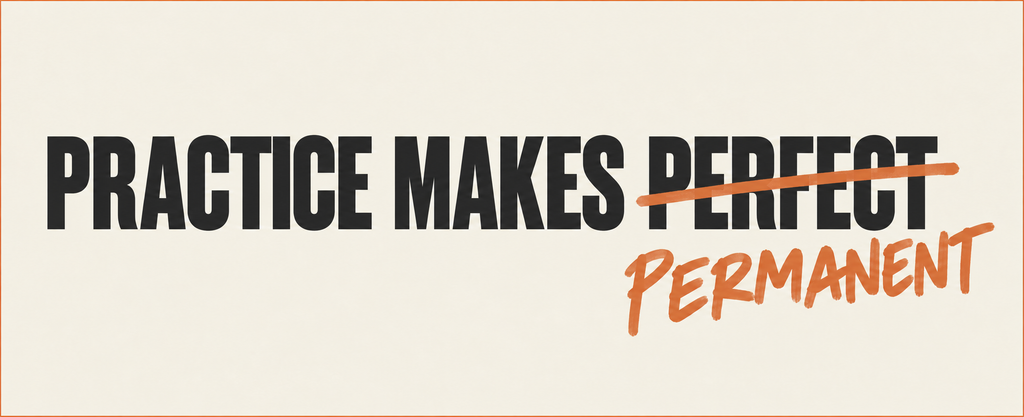
The phrase practice makes perfect is often repeated, but this does not make it any less incorrect. A more useful principle, and the one this whole series is built on, is:
Practice makes permanent.
Whatever you repeatedly ask your brain and body to do becomes more familiar and more available. That includes efficient movements and awkward ones, good timing and bad timing, ease and unnecessary tension. Practice, then, is not really about repetition at all. It is about causing a useful change.
Practice is not the same as playing
When you first learn a bass line, almost everything needs conscious attention. The notes, the rhythm, the fingering, which string, what the plucking hand is doing, whether anything unwanted is ringing. With learning, more of those processes run without supervision.
What musicians call muscle memory is learning in the nervous system. The muscles do not remember the bass line. The brain gets better at organising the perception, timing and movement required to produce it.
Motor learning changes the nervous system in several ways at once. One part of that story is myelin, the insulating sheath around many nerve fibres, and there is good evidence that motor learning can affect myelination even in adulthood. But the pop neuroscience version, in which every correct repetition politely adds another layer of insulation, is far too tidy. Learning also alters synaptic strength, sensory maps, coordination between brain regions, and the strategies you use to solve the task in the first place.
The wider point is more useful than any single mechanism. Practice alters the system doing the practising. Repetitions are never neutral. You are continuously telling your nervous system what should become easier to do.
Mistakes are information
I don’t want to give the impression that “practice makes permanent” is a command that you must never play anything wrong. It is not. Mistakes are, in a way, good.
Or more accurately, mistakes are structurally necessary. “Mistakes” are a measure of the distance between what you intended and what actually happened. Without that gap there is nothing to learn from.
The problem is not making an error. It is repeating one without extracting anything from it.
Molly Gebrian, a violist with a background in cognitive neuroscience, makes this distinction clear in her wonderful book Learn Faster, Perform Better. She reminds us that better practisers do not live in some error free world. However, they are faster at responding to error: identifying what failed, targeting it, and changing the next attempt.
So if you miss the same shift five times, a sixth run at the whole phrase is unlikely to help. Instead, you must enquire into what actually failed. (Did the hand set off too late? Did the previous finger stay down too long? Is the fingering asking for something the hand cannot do? Were you playing intentionally: did you know where you were going, or were you hoping?) That last question catches more students than the other three combined.
Good practice is about intentionality and is based on an information loop:
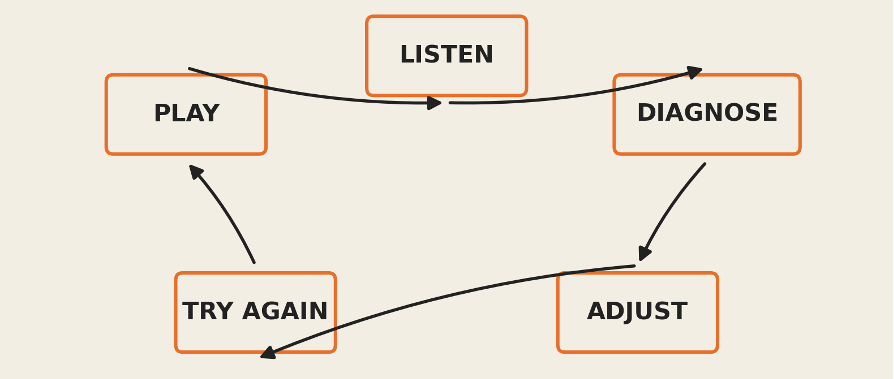
In this system, a repetition earns its place when what you learned from the last one has changed this one.
Make the problem smaller
Josh Waitzkin (child chess prodigy and subject of the film Searching For Bobby Fischer, and later a world champion in the martial art push-hands and BJJ black-belt), blesses us with a wonderful idea in The Art of Learning. He describes making smaller circles: take something complicated and keep reducing it until you can study its essential component in depth.
For a musician, a difficult four bar phrase usually contains only one difficult bar. That bar contains one awkward beat. That beat contains one troublesome movement between two notes.
Practise that.
Play the first note. Move deliberately to the second. Then join them. Then add the note before, then the note after. Rebuild outwards.
This transforms the economics of practice. Playing a sixteen bar section ten times gives the troublesome movement ten repetitions, most of them arrived at while distracted. Isolating a two note transition gives it ten attentive repetitions in under a minute.
So the useful question is not “what can’t I play?” It is:
What is the smallest thing here that I cannot yet do reliably?
That is usually where the real practice starts.
The piano maestro Bill Evans makes the same argument in the 1966 film The Universal Mind of Bill Evans. Asked how a musician should begin, he warns against reaching straight for the advanced thing:
“It’s better to do something simple which is real. It’s something you can build on because you know what you’re doing. Whereas, if you try to approximate something very advanced and you don’t know what you’re doing, you can’t build on it.”
Bill Evans, The Universal Mind of Bill Evans (1966)
That is the smaller circle, described from the other direction. Find the version of the problem you actually understand, and build outwards from there.
Slow enough to notice
Slowing down is the fastest way to make that smaller problem visible. At tempo, an error can be over before you have understood its cause. At a slow tempo you have time to hear whether each note is clean, feel unnecessary tension, reconsider the fingering, and notice how one movement sets up the next.
Slow practice is not valuable because slowness is virtuous. It is valuable because slowness increases resolution.
Of course, this is a tool, not a destination. Fast playing is not slow playing accelerated: at speed, movements compress, notes group into larger units, and a fingering that felt spacious at 60 bpm can become clumsy at 140. So the skill eventually has to meet something close to its real conditions.
A useful progression:
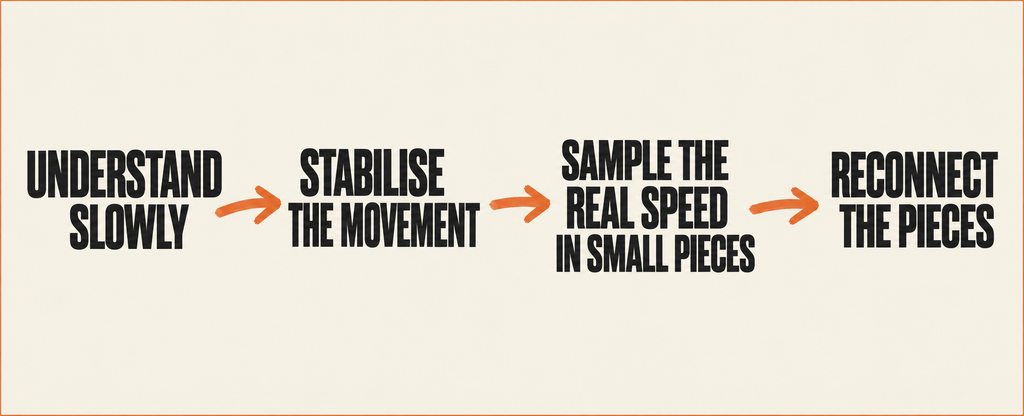
For a fast line, practise four notes slowly to understand the movement, then practise those same four notes at the eventual tempo. You do not have to survive the whole passage yet. You are giving yourself a controlled experience of what the real speed demands.
Correct repetition, and the danger of feeling good
Once you have found a good solution, repeat it correctly a few times. I often use five clean, intentional repetitions as a rough signal that we are ready to move on. The point is to make sure the successful version receives enough attention to begin becoming familiar.
There is another trap, though. Twenty successful repetitions in a row can make something feel wonderfully secure because every attempt is supported by the one immediately before it. That feeling is not necessarily the same as learning.
Blocked practice, that is: repeating A, then A again, then A again, can produce what learning researchers call an illusion of mastery. Interleaving, where you move between different passages or tasks and return later, often feels worse during practice but can produce more reliable later performance.
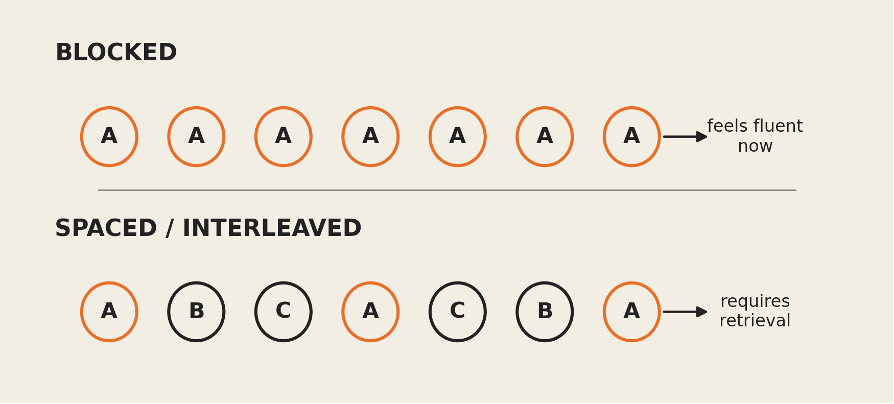
Once a passage is basically understood, leave it. Work on something else. Come back five or ten minutes later and try it again. If it has deteriorated slightly, that is useful information. Now you are practising not only the movement but the ability to retrieve the movement after it has left the front of your mind.
Not practising is a key part of practising
Improvement does not only happen while you are playing. The nervous system carries on consolidating after the case is shut, and sleep appears to support that consolidation for many kinds of learning. The literature is more nuanced than the popular claim that sleep reliably adds an overnight bonus, so it is safer to say sleep supports consolidation than that an early night will add ten bpm to your semiquavers.
This gives practice several timescales. Repetition within a minute. Returning later the same session. Returning tomorrow. Returning next week. Each asks a different question: can I repeat it, can I retrieve it, has it stuck? On each time scale breaks are helpful.
You will recognise the experience of fighting something all evening, sleeping, and finding it noticeably calmer in the morning. The practice was not failing when you stopped. Part of it simply happens away from the instrument.
Once it works, disturb it
In the 1920s, at the Central Institute of Labour in Moscow, a physiologist called Nikolai Bernstein filmed expert blacksmiths striking a chisel with a hammer. He attached small lights to the blacksmiths’ shoulder, elbow and wrist joints and photographed the lights’ traces. He expected to find that expertise meant repeating an identical movement.
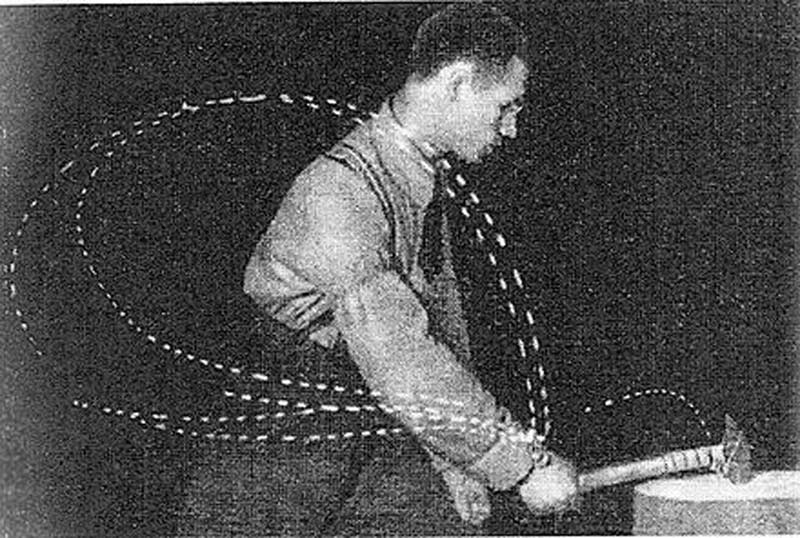
He found the opposite. The trajectory of the hammer tip was highly consistent from strike to strike. The trajectories of the shoulder, elbow and wrist were not. The joints varied, and their variation compensated, so that the endpoint arrived in the same place by a slightly different route every time.
Bernstein called this repetition without repetition, and it is a very useful idea for musicians. It implies that the goal of practice is not a single, stable frozen movement. It is a reliable outcome produced by a flexible system. Early on, consistency helps: you need a workable solution before you start varying things. But once the movement is stable, variation makes it stronger.
Play the passage at another tempo. Start from the middle. Play it quietly, then hard. Use a drum loop instead of a metronome, then nothing at all. Put the bass down for a minute and come back cold.
Real performance is variable. The room changes, the drummer changes, the tempo changes, your hands are cold, the monitor cuts out, the singer calls a different key. A skill that only works under the exact conditions in which it was learned is not yet a skill. It is a rehearsal.
Again, we are training a flexible system to produce a reliable outcome. Eventually then the question stops being “can I repeat this?” and becomes “can I produce this outcome when the circumstances change?” That is also the point where practice blossoms into musicianship.
Listen
All of this rests on attention. This is an exercise in directing and marshalling your attention. It is entirely possible to get so absorbed in the fingers that you stop listening to what the fingers produce. Your ears stop functioning as the audience providing feedback into the mechanism, and instead become appendages peripheral to the mechanism.
Cultivating the ability to really listen as you play is a key skill. (On this, I highly recommend the film Oscar’s Lesson about Oscar Ghiglia, who has been hugely influential on my approach and who elevates listening to a rarified art form).
Is the note clean? Was I rushing or was I dragging? Where does it end? Is anything else ringing? Does it sit with the kick drum? Are you using more force than the sound requires? How are my dynamics? Is my tone appropriate? Does it sound like music, or like an exercise wearing a costume?
One of the most valuable things a musician can develop is the ability to notice a problem without waiting for someone else to name it. Over time, practice should make you increasingly capable of being your own teacher. That may be the deeper reason for practising slowly, isolating material and listening closely. All three improve your capacity to notice.
And the more you notice, the more precisely you can practise.
Practise what you cannot do
There is a final difficulty: effective practice often does not sound impressive. Playing something you already know from beginning to end feels good. It’s comfortable. Spending ten minutes investigating one ugly shift does not. The second activity is far more likely to change your playing.
Waitzkin calls this investment in loss: accepting short term difficulty in order to expose weakness and build something better. Musically, it means being willing to spend time sounding bad, or being uncomfortable with how you sound, on purpose, with purpose.
A good (as in “effective”) session can therefore seem really bad (as in “there wasn’t much music played”) from the perspective of an external observer.
A challenging session and a bad session are not at all the same. Difficulty is information. The trick is to keep it informative. If you fail twenty times in an identical way, determination is not the missing ingredient. Often getting better is not a question of trying harder, it is changing the conditions to accommodate challenge and build flexibility: slow it, shorten it, change the fingering, drop the pitches and play only the rhythm, sing the line, or stop for a bit.
Good practisers are not simply persistent. They are sensitive to difficulty when they encounter it, recognise it as information about an area that needs attention, then work through how to change the practice to obtain the outcome sought, and then to make it flexible.
Practise, then play
There is a real and important difference between practice mode and performance mode. In practice mode you stop, diagnose, isolate and correct. In performance mode you keep going and recover without interrupting the music. It is important to invest time in developing both. You should always know which mode you are looking to operate in when you are on the instrument.
On this, it seems to me that most musicians are way too casual about practice and way too intense about performance. My approach is to be rigorous, intense and serious about practice, so that I can be carefree, relaxed and liberated on the bandstand. “Bleed in the gym, so that you don’t bleed in the ring”, as I believe they say in the boxing game.
So sweat the details (practice). Then run the thing (performance). Record it in one take (performance). Notice what happens under even that small amount of pressure, then go back to repair whatever the recording exposed (practice).
And, of course, sometimes just play, because playing is the thing. There is a difference between practising the bass and playing the bass, and a musical life has both.
Practice should change something
The idea that mastery is a matter of accumulating a set number of hours has always weirded me out.
Task relevant, structured practice is strongly associated with musical achievement, and the researchers who study it argue vigorously about how strongly. One large meta analysis put deliberate practice at around 21 per cent of the variance in music performance; another group, looking specifically at music, found a considerably stronger relationship. Both camps agree on the thing that actually matters to you: practice is necessary, practice quality varies enormously, and hours alone explain neither the ceiling nor the floor.
Which is good news, incidentally. If quality matters as much as quantity, then a musician with a job, a commute and a small child is not automatically condemned to slow progress.
So instead of measuring practice with the clock, I measure mine by intentionality and outcome:
Was the time spent well, with my attention focused on what I was doing? What can I now do, hear or understand that I could not before?
When something goes wrong, make the circle smaller. Slow down until you can perceive it. Find a better solution. Repeat that solution. Leave it alone. Come back and find out whether it survived. Then vary the conditions until you know it will work when you need it.
Pablo Casals was asked, at ninety, why he still practised three hours a day. He is supposed to have said:
“because I think I am making progress.”
The point of all this is not to become especially good at practising. You are creating freedom; as you train the mechanics to become efficient, the timing to be effortless, as the knowledge soaks in, as it all becomes, in a word, easy, you free up cognitive bandwidth to think about something else: listening intently, the details of what is going around you, time feel, sound, the people you are playing with, and what the music is actually trying to do. You are free. You can really Play.
Practice makes permanent.
So pay attention to what you are making permanent.
Next in the series: Practice Is Not Playing: What Deliberate Practice Actually Means.
FAQ
What does “practice makes permanent” mean? It means your nervous system consolidates whatever you repeatedly do, not whatever you intended to do. Repeating a passage with poor fingering or unnecessary tension makes that version more automatic, not less. The quality of each repetition matters more than the number of them.
How long should I practise each day? Frequency matters more than duration. Twenty focused minutes most days will beat a two hour session once a week, because learning depends on repeated retrieval across separate sessions rather than on total contact time. (An article to follow on how to build a routine that survives a real week.)
Why do I play something perfectly in practice and then lose it the next day? Usually because you were repeating rather than retrieving. Twenty consecutive successful attempts feel secure because each one is supported by the last. Leave the passage for ten minutes and come back to it: if it degrades, you have found the real state of the skill, which is useful information rather than a failure.
Is it bad to make mistakes when practising? NO. Mistakes are how we see the gap between intention and result. “Bad” would be repeating a mistake without diagnosing it, or applying attention to it. Aim for a level of difficulty where you can discern why an attempt failed.
I teach one to one bass in Leith, in person and online. If you’re interested in organising a session, get in touch.